

How Small Home Improvements Can Restore Order, Energy, and Hope
Discover how to create a home that builds you up. Discover how manageable home improvements can reduce stress, restore order, encourage your family, and turn your home into a place that supports your best life.
A real home is more than walls, a roof, furniture, and a list of repairs. It’s where ordinary life unfolds.
It is where mornings begin, families gather, meals are shared, difficult conversations happen, children grow, and tired people return at the end of the day. Our homes hold celebrations and disappointments, work and rest, noise and quiet. They influence how we feel more deeply than we sometimes realize.
When a home supports us, it can provide calm, safety, dignity, and energy. When it becomes cluttered, neglected, unsafe, or filled with unfinished jobs, it can quietly drain us. A dripping tap is not merely a dripping tap after six months. It becomes a reminder of something unresolved. A dark room can affect mood. A damaged entrance can make the entire property feel uncared for. A long repair list can make it feel like life itself is out of control.
The good news is that transformation does not always require a huge renovation or an unlimited budget. Small, purposeful improvements can restore more than a room. They can restore momentum, confidence, and hope.
Your Home Is an Environment, Not a Showpiece
It is easy to compare our homes with professionally styled images online. Those rooms are arranged for a camera, not for the full complexity of daily life.
Real homes contain laundry, tools, school bags, medication, pet hair, paperwork, memories, and people with different habits.
Your home does not have to impress strangers. It should serve the people who live there.
Before starting any home improvement project, ask what you want the space to help you experience. Do you need better sleep? Easier cleaning? Safer movement? Less visual clutter? More useful storage? A comfortable place for conversation? Lower energy costs? A garden that draws you outdoors?
When purpose leads, design decisions become clearer. A beautiful chair that nobody can sit in comfortably is not an improvement. An expensive kitchen that makes daily tasks harder has missed its purpose. The best upgrade is not necessarily the one that photographs well; it is the one that improves real life.
Find Your Compass in the Renovation Storm
Homeowners often live in a storm of competing demands. The gutters need cleaning, a room needs paint, energy bills are rising, the garden is overgrown, a cupboard is disorganized, and a mysterious sound has started somewhere near the heating system.
When everything appears urgent, we may do nothing. Overwhelm turns a list of manageable tasks into one enormous emotional burden.
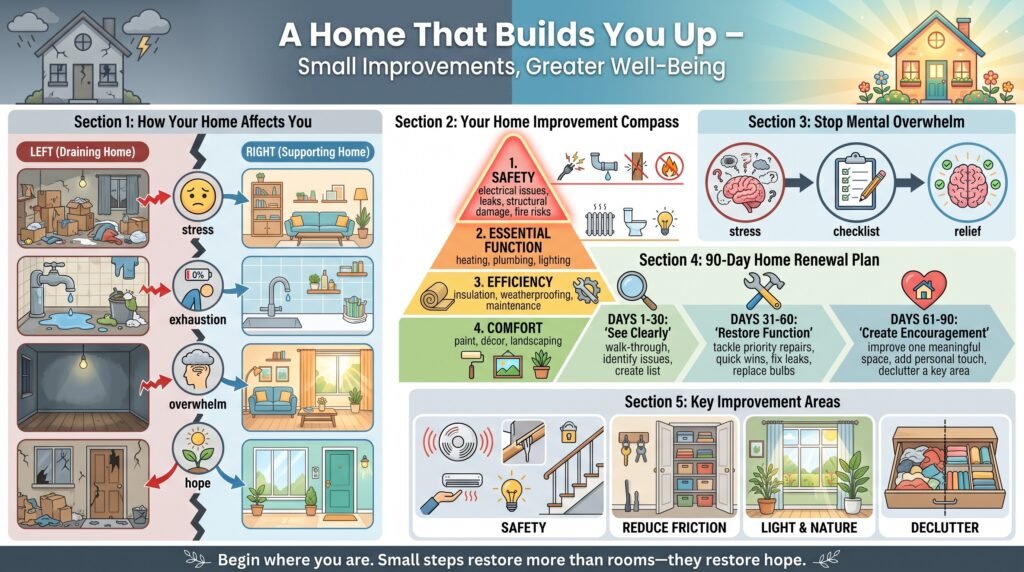
Create a simple compass for your home:
This month will be a win if we complete the one improvement that most increases safety, comfort, function, or peace.
Then sort projects into four groups:
- Safety and damage prevention: electrical faults, active leaks, structural concerns, fire risks, dangerous steps, mould sources, pest entry, and failing locks.
- Essential function: heating, plumbing, ventilation, appliances, lighting, and rooms that cannot be used properly.
- Efficiency and maintenance: insulation, weather sealing, drainage, servicing, and preventive work.
- Comfort and appearance: paint, furnishings, décor, landscaping, and convenience upgrades.
This order prevents an attractive project from consuming resources needed for an urgent one. It also gives your mind permission to focus. You do not have to solve the entire house today. You need to identify the next right improvement.
Stop Carrying Every Unfinished Job in Your Head
An unrecorded task keeps reminding you that it exists. That mental repetition creates stress.
Walk through the property and make one complete list. Include repairs, maintenance, safety concerns, clutter zones, and improvements you would enjoy. Add photographs or measurements where useful. Once you’ve captured everything, your mind no longer has to act as the storage system.
Now mark each item by urgency, cost, effort, and impact. You may discover that a few small tasks are creating a large share of the frustration. A broken handle, harsh light bulb, loose hinge, chaotic drawer, or missing hook can irritate you every day while requiring little time to fix.
Choose several quick wins, but also identify the most important substantial task. Quick wins create energy; the important task creates meaningful progress.
Keep one “later” list. Not every good idea belongs in the current budget or season. Consciously postponing something is different from neglecting it. It means, “This matters, but it is not the priority now.”
Begin Small, but Begin
People often postpone improvement because they cannot yet afford or manage the ideal version. They imagine a completely new kitchen, so they live for years with a space that can be improved through better lighting, repaired hinges, organized storage, fresh sealant, or paint.
The perfect can become the enemy of the useful.
Ask what can be repaired, cleaned, rearranged, repurposed, or improved before it is replaced. A deep clean can reveal what a room actually needs. Moving furniture may improve flow. A lamp can transform a dark corner. Sealing an air leak can increase comfort. One shelf can end daily clutter.
Small work is not meaningless work. Every large renovation is a sequence of smaller actions: measuring, planning, choosing, ordering, preparing, installing, checking, and finishing. Momentum begins when the first action is completed.
If you feel stuck, give yourself fifteen minutes – clear one surface. Tighten one screw. Request one quotation. Research one material. Book one inspection. Motion changes a project’s emotional temperature.
Safety Is the Most Encouraging Upgrade
Some improvements are exciting because they change what we see. Others matter because they protect what we love.
Check smoke and carbon monoxide alarms according to local guidance. Keep exits clear. Repair loose rails and uneven walking surfaces. Improve lighting on stairs and at entrances. Address water intrusion and persistent damp rather than merely covering the mark. Have appropriately qualified professionals assess suspected electrical, gas, structural, or serious pest problems.
Safety becomes increasingly important as households age. A home that worked perfectly at forty may create difficulty at seventy. Good lighting, lever handles, secure handrails, non-slip surfaces, reachable storage, and an accessible shower can preserve independence without making a home feel institutional.
Do not wait for an accident to make obvious changes. Prevention is an act of care.
Build a Home That Reduces Daily Friction
We often think about design in terms of style, but function has a powerful emotional effect. Repeated inconvenience consumes energy.
Notice where daily life catches:
- Where do keys and mail accumulate?
- Which items are constantly carried between rooms?
- Where is there never enough light?
- Which cupboard is difficult to use?
- Where do people trip, squeeze past, or interrupt one another?
- Which cleaning task is harder than it needs to be?
The answers reveal high-value home improvements. Create a place for frequently used items near where you use them. Add storage where clutter naturally appears, not where a catalog says it belongs. Improve task lighting. Remove furniture that obstructs movement. Choose finishes that match the reality of children, pets, hobbies, or mobility needs.
A functional home gives you back small amounts of time and patience every day.
Let Light, Air and Nature Do Their Work
Now and again, look at something not made by human hands: a tree, a cloud, a bird, the changing light, or the movement of water. Nature restores perspective.
Your home can strengthen that connection. Clean windows, open curtains where privacy permits, trim vegetation that blocks useful daylight, and position a chair where you can see the garden or sky. Use mirrors carefully to carry light into darker areas. Choose warm, comfortable artificial lighting for the evening and brighter task lighting where concentration matters.
Ventilation is equally important. Fresh air helps a home feel alive and can help manage moisture, although ventilation strategies must suit the local climate and building. Address sources of damp and use extraction in moisture-producing areas.
A garden does not have to be large or perfect. A pot of herbs, a flowering plant, a responsibly positioned bird feeder, or a comfortable outdoor chair can create a daily invitation to pause.
Decluttering Is About Making Room for Life
Clutter is not a character defect. It often grows from busy seasons, grief, changing family needs, postponed decisions, or possessions that once served a life we no longer live.
Approach it without shame.
Start with one small category or area – not the whole house. Decide what should remain, what can be given to someone who will use it, what should be recycled, and what has reached the end of its useful life. Keep items that are useful, meaningful, or beautiful to you, but recognize that memories do not always require every object connected to them.
Create limits that fit the available space. A shelf, drawer, or cupboard is a natural boundary. When the container is full, choose what deserves the room.
The goal isn’t an empty home. It is a home in which the things you value can be found, used, and appreciated. Removing excess creates physical space, but it can also create emotional breathing room.
Plan Before You Spend
Enthusiasm can make a project feel urgent. Good planning protects that enthusiasm from becoming expensive regret.
Define the problem before choosing the product. Measure carefully. Consider the work that must happen before and after installation. Include delivery, disposal, preparation, finishing, permits, and professional fees in the budget where applicable. Keep a contingency for discoveries behind walls or beneath floors.
For larger work, compare quotations on the same scope. A low price may exclude important items; a higher price may include better preparation, materials, protection, or warranties. Check qualifications, insurance, references, and local rules. Put the agreed scope, timing, payment terms, and changes in writing.
Do not allow pressure to replace judgment. A reputable professional should be able to explain the work, limitations, and cost. If you do not understand, ask again.
Planning may feel slower at the start, but it often saves time, conflict, and money later.
Work With the Home You Have and the Life You Live
Homes pass through seasons just as people do. A nursery becomes a study. A formal dining room becomes a place for crafts or remote work. A spare bedroom may need to welcome an aging parent or visiting grandchildren. Retirement can change how much time we spend at home and what we need from it.
Don’t stay trapped by a room’s original label. Let your present life guide its function.
Your experience also gives you an advantage. With age, many people become clearer about what they actually enjoy and less interested in maintaining spaces or possessions merely for appearance. Use that clarity. Create a home that supports your routines, relationships, health, hobbies, and plans.
This may mean reducing maintenance, improving accessibility, creating a quiet place for prayer or reading, organizing a workshop, or making the main living area easier for family gatherings.
A successful home is not frozen in time. It adapts without losing its character.
A House Becomes a Home Through Presence
No surface, fixture, or color scheme can replace the emotional atmosphere created by the people inside.
One of the most powerful things you bring home is your presence. Family members may forget the exact meal, furniture, or words spoken on an ordinary evening, but they remember whether home felt tense or peaceful, critical or encouraging, unpredictable or safe.
Take care of your mind before you cross the threshold. Process frustration instead of passing it on automatically. Listen with attention. Notice effort. Speak appreciation aloud. A sincere “thank you,” “I see what you did,” or “I’m glad you’re here” can improve a home more profoundly than an expensive purchase.
This does not mean avoiding necessary boundaries or difficult conversations. A healthy home makes room for truth and respect. It allows people to disagree without destroying one another’s dignity.
The most memorable homes are not always the largest or most fashionable. They are the places where people feel welcome, seen, and able to breathe.
Invite the Family Into the Vision
Improvements affect everyone who uses the space. Ask household members what frustrates them and what would make daily life easier. You may be surprised. The feature one person considers essential may barely matter to another.
Shared planning creates ownership. Children can help with age-appropriate tasks. Couples can agree on priorities before entering a showroom. Older relatives can explain mobility or comfort needs that are not obvious to others.
Not every preference can win, but every voice can be heard.
For a family project, define the shared outcome: “We want this room to make it easier to eat together,” or “We want the entrance to be safe, organized, and welcoming.” A common purpose helps resolve individual design disagreements.
Teamwork does not remove every challenge. It reminds us that we are improving a life together, not merely completing a task.
Know When to Continue and When to Rest
Projects can consume every free hour if we let them. There is always another surface to paint, plant to prune, or detail to perfect.
There is a time to press forward and a time to pause. Both are acts of strength.
Rest reduces mistakes, protects relationships, and lets you return with clearer judgment. If fatigue makes you careless, irritable, or likely to take unsafe shortcuts, stopping is productive.
Set sensible working hours. Protect meals and family time. Finish at a safe stopping point. Celebrate milestones before immediately focusing on what remains undone.
Your home exists to support life. If improving it repeatedly damages your health or relationships, the process needs adjustment.
Practice Gratitude While You Improve
It is possible to become so focused on what is wrong with a home that we stop seeing what it already gives us.
Walk through each room and name something for which you are thankful. The table may hold scratches because a family gathered around it. The small garden may have given you peaceful mornings. The worn floor may carry years of footsteps. Imperfection and meaning often live together.
Gratitude does not mean ignoring maintenance or accepting unsafe conditions. It changes the spirit in which we improve. Instead of saying, “This house is a disaster,” we can say, “This home has served us, and now we will care for its next need.”
Thank the people who help maintain it. Much of the work that makes a home function is repetitive and nearly invisible. Notice it.
When gratitude leads, improvement becomes stewardship rather than endless dissatisfaction.
Create a Ninety-Day Home Renewal Plan
You do not have to transform everything at once. Use a simple ninety-day plan.
First thirty days: See clearly
Complete the walk-through. Identify safety issues, maintenance needs, frustration points, and one area that would bring joy. Set a realistic budget.
Second thirty days: Restore function
Address the highest-priority repair or maintenance item. Complete several quick wins that reduce daily friction. Bring in qualified help where necessary.
Final thirty days: Create encouragement
Improve one space where you begin the day, rest, or connect with others. Add order, comfortable light, something from nature, and one meaningful personal element.
Keep a short record of completed work. Photographs can make gradual progress visible. At the end of the cycle, ask what improved safety, comfort, energy use, time, or family life. Then choose the next season’s priority.
Your Home—and Your Life—Are Still Becoming
A home is never truly finished. Materials age, needs change, and the people inside continue growing. That is not failure; it is life.
Do not be discouraged by the entire distance between what you have and what you imagine. Set your compass and take the next step. Repair what protects. Simplify what frustrates. Improve what serves. Remove what weighs you down. Create space for rest, laughter, work, prayer, and the people you love.
Every thoughtful improvement says, “Our daily life matters.” Every repaired danger says, “The people here are worth protecting.” Every welcoming chair says, “There is a place for you.” Every cleared surface says, “We can begin again.”
You may be changing a room, but the process can also change you. It teaches patience, planning, creativity, perseverance, and gratitude. It proves that progress does not require perfection and that a series of small actions can produce a remarkable transformation.
Begin where you are. Use what you have. Ask for help when you need it. Do the next right thing.
Build a home that does more than shelter you. Build one that restores your energy, supports your purpose, welcomes others, and reminds everyone who enters that hope lives here.
A better home is not only something you see. It is something you feel – and something you help others feel.
Leave a Reply