

Most people starting in real estate get told to be patient, keep their head down, and wait for commissions to slowly trickle in over their first year.
That conventional wisdom might keep you safe from disappointment, but it’s also a really good way to end up with $30,000 in your bank account after twelve months of grinding. The solution to the question of how to make $100,000 your first year in real estate happens when you understand the math, pick the right market, and execute a specific strategy that doesn’t rely on luck or waiting for your phone to ring.
Most new agents fail to hit six figures because they treat real estate like a hobby rather than a business that demands serious volume, strategic positioning, and access to higher-priced inventory. The answer comes from understanding exactly how the numbers work and reverse-engineering your path to $100k before you even get your license.
Affiliate Disclaimer: This post may contain affiliate links, meaning we earn a commission if you purchase through them – at no extra cost to you. We only recommend products or services we believe add value to our readers.
The Real Math Behind Six Figures
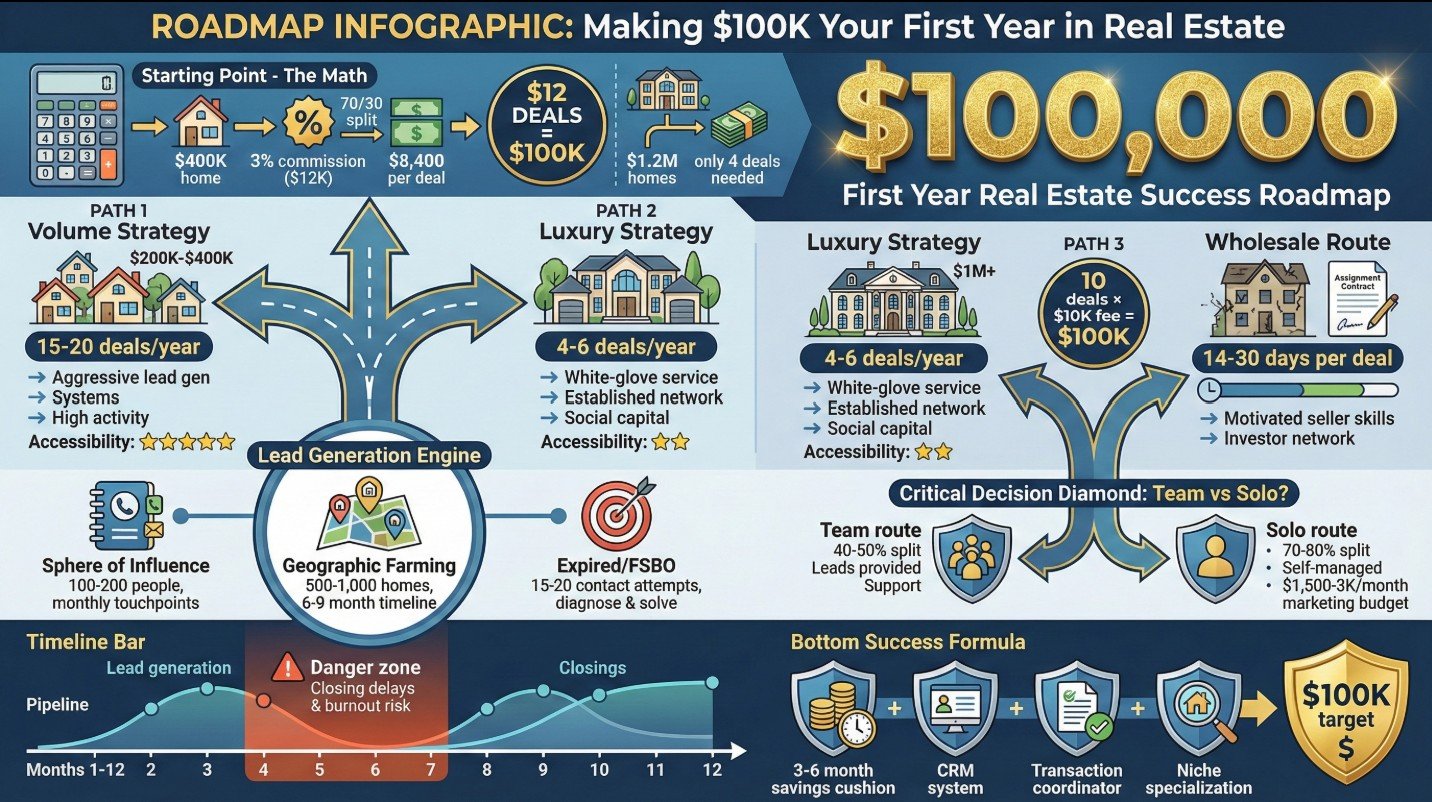
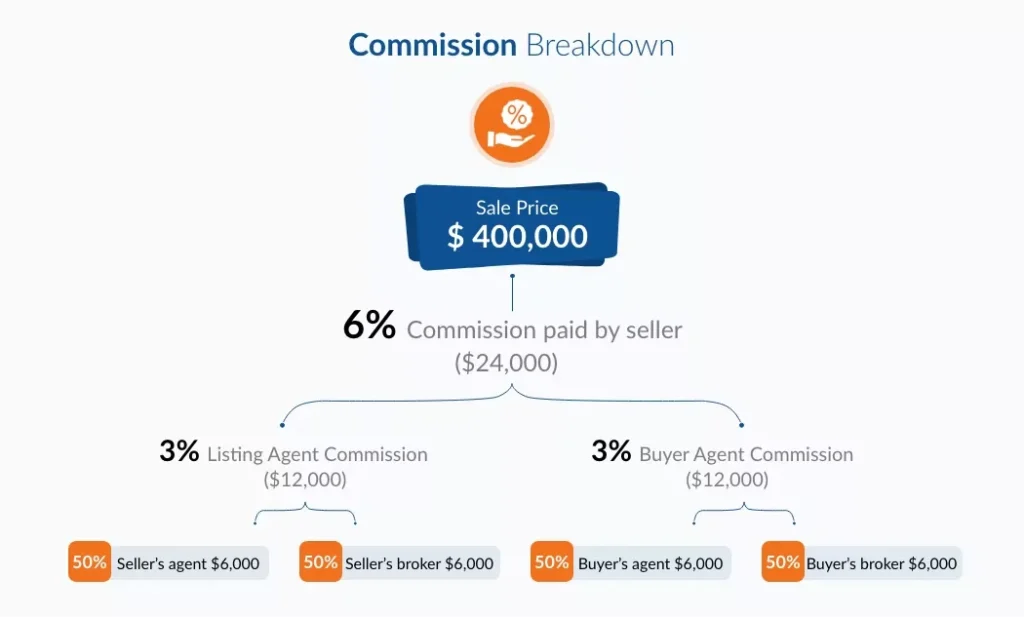
Getting brutally honest about what $100,000 actually needs in year one starts with understanding commission structures. When working as a traditional buyer’s or listing agent, you typically earn a 2.5% to 3% commission on each transaction, but that’s not what hits your bank account.
Your brokerage takes its split first, anywhere from 20% to 50%, depending on where you hang your license. In a market where the median home price is $400,000, and you’re earning a 3% commission with a 70/30 split in your favor, each transaction puts $8,400 in your pocket before taxes and expenses.
To hit $100,000, you need about 12 closed transactions in your first year. That’s one deal per month, which sounds reasonable until you factor in the reality that most transactions take 60 to 90 days from initial contact to closing.
You need to be generating leads and building relationships in months one through three that won’t pay you until months three through six. Pipeline delays are what kill most new agents.
They celebrate their first closing in month four, then realize they forgot to keep prospecting and suddenly face a two-month income drought.
In a higher-priced market like San Jose, California, where the average home price hovers around $1.2 million, the math changes dramatically. Just four transactions at that price point with similar commission structures get you to $100,000.
Location matters more than almost any other factor in your first-year earnings.
The difference between markets is not about price points. Higher-priced markets need different skills, different marketing approaches, and often different social capital to break into.
You need to decide which path best aligns with your existing resources and capabilities.
High-Value Markets vs. Volume Markets
You have two basic paths to six figures: sell fewer expensive properties or sell more affordable properties. Both work, but they demand completely different skill sets and strategies.
In luxury markets, you’re dealing with sophisticated buyers and sellers who expect white-glove service, professional marketing, and an agent who understands the nuances of high-net-worth transactions. Breaking into these markets as a new agent is genuinely difficult because wealthy clients typically work with experienced professionals who have proven track records.
You’ll need to either join a team that handles luxury listings or find a unique angle of entry. Maybe you have worked in wealth management, or you have connections through country clubs, charity boards, or professional networks.
Without some existing pathway into affluent circles, you’ll spend six months just trying to get meetings while your savings account drains.
The volume approach means operating in markets where homes sell for $200,000 to $400,000, and you need to close 15 to 20 deals in your first year. This is absolutely doable, but it needs systems, discipline, and aggressive lead generation.
You’re essentially running a small manufacturing operation that requires constantly feeding the pipeline, converting leads efficiently, and managing many transactions simultaneously.
Some new agents succeed with both approaches, but the volume strategy is more accessible for most people because it doesn’t need the social capital or experience that luxury clients demand. You can win on sheer activity and responsiveness in the middle-market real estate market.
When you answer your phone on the first ring at 8 PM on a Saturday, you’re competing directly with agents who have 15 years of experience but have gotten comfortable and complacent.
The volume approach also teaches you the business faster. Handling 15 transactions in your first year means you’ll encounter virtually every problem that can arise in a real estate deal.
You’ll learn how to navigate inspection issues, financing problems, title complications, and difficult personalities.
By month six, you’ll have more practical experience than agents who have been in the business for three years but only close four deals annually.
The Wholesale Real Estate Alternative
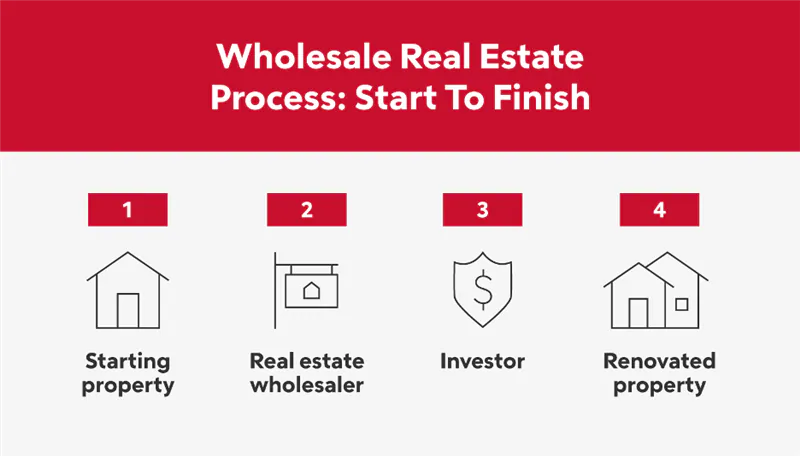
Wholesale real estate offers a completely different income model that can actually produce faster results in your first year. As a wholesaler, you’re finding distressed properties, getting them under contract at below-market prices, and then assigning that contract to an investor for a fee.
Your typical assignment fee ranges from $5,000 to $15,000 per deal, and you don’t need a real estate license to do this in most states (though having one doesn’t hurt). The math here is straightforward: 10 wholesale deals at $10,000 each add up to $100,000.
The timeline is also faster because you’re not waiting for mortgage approvals, inspections, and all the complications that come with retail transactions. Many wholesale deals close in 14 to 30 days.
The challenge with wholesaling is finding motivated sellers and building a buyers list of investors who can close quickly. This needs different skills than traditional real estate sales.
You need to be comfortable with direct mail campaigns, cold calling property owners in pre-foreclosure, working with probate attorneys, and analyzing deal numbers quickly to make offers that work for both you and your end buyer.
Wholesaling also faces some legal scrutiny in certain markets, so you need to understand the regulations in your state. Some states require a license to wholesale properties, while others are more permissive.
The ethical way to wholesale is to be able to close on properties yourself if your assignment falls through, which means having access to capital or hard-money lenders.
The skill set you develop as a wholesaler translates directly to traditional real estate if you decide to pivot. You become really good at finding off-market deals, understanding property values, negotiating with motivated sellers, and moving quickly when opportunities arise.
Building Your Lead Generation Machine
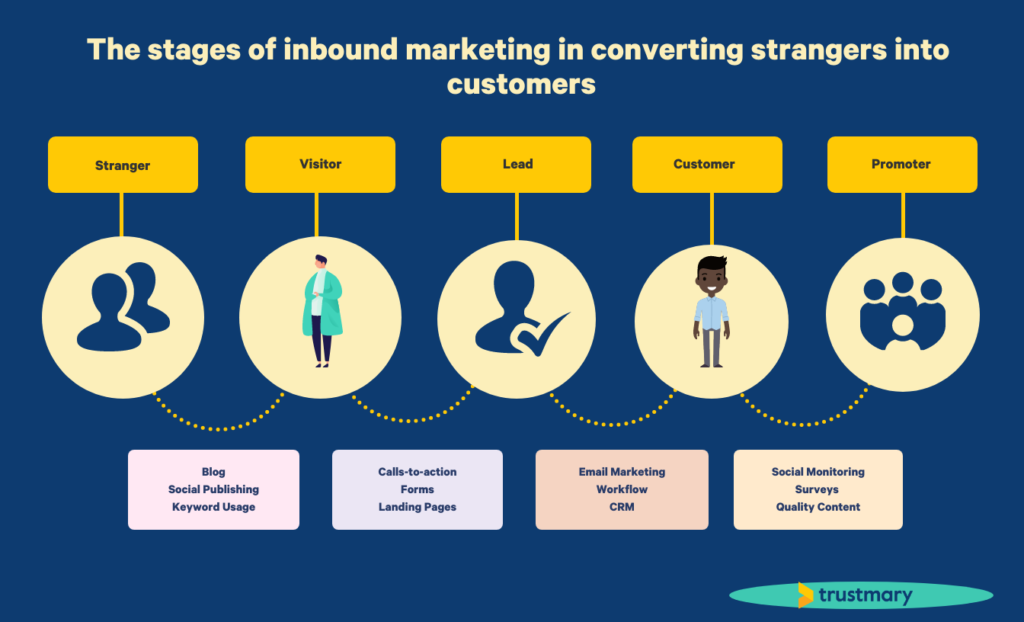
Everything depends on consistent lead generation. Most new agents completely fail because they take a scattered approach, posting randomly on social media, hoping someone at a party mentions they want to buy a house, or waiting for their broker to hand them a lead.
You need to pick two or three lead-generation methods and execute them with absolute consistency throughout the year. Doing ten different things poorly produces worse results than doing two things exceptionally well.
Here’s what actually works for new agents with limited budgets.
Sphere of Influence Activation
Everyone tells you to “work your sphere,” but most people do this halfheartedly. Real sphere activation means creating a database of every single person you know, and I mean everyone, from your dentist to your high school friends you haven’t talked to in ten years, and systematically staying in front of them with value.
Send a monthly email newsletter with local market updates, host quarterly client appreciation events, make personal phone calls on birthdays, and position yourself as the obvious choice when anyone in your network thinks about real estate. The goal is 100 to 200 people who know exactly what you do and think of you first.
One of the most successful first-year agents made $120,000 in year one by sending handwritten notes to 50 people every single week, combined with monthly video messages highlighting new listings and market trends. His sphere became his referral engine, and by month eight, he wasn’t prospecting anymore because his database was feeding him deals.
The key distinction here is that most agents announce they got their license on Facebook, post a couple of listings, and wonder why nobody calls them. Your sphere needs to hear from you at least once a month, preferably more often.
They need to see you as a professional who understands the market, not just someone who decided to sell real estate because they couldn’t figure out what else to do with their life.
Geographic Farming
Pick a neighborhood with 500 to 1,000 homes and become the dominant real estate presence there. This means sending direct mail every month, knocking on doors every week, hosting community events, and genuinely becoming part of that neighborhood’s fabric.
Most agents give up on farming after three months because they don’t see immediate results. The reality is that geographic farming takes six to nine months before you start seeing consistent listing opportunities.
But once you’re established, you can convert 2% to 5% of that farm annually, which means 10 to 50 transactions from a single concentrated area.
The key is consistency and providing actual value beyond just “I sold a home on your street” postcards. Share information about local businesses, crime statistics, school updates, and community events.
Become the neighborhood expert who happens to sell real estate, not just another agent spamming mailboxes.
Door knocking is especially effective in geographic farming because you’re not directly asking for business. You’re introducing yourself, asking whether they know anyone who’s thinking about selling, and leaving a helpful market report or neighborhood guide.
Most people are surprisingly receptive when you’re genuinely trying to provide value rather than immediately asking them to list with you.
Expired and FSBO Outreach
This is where new agents can compete directly with veterans because expired listings and for-sale-by-owner properties represent motivated sellers who need help right now. These aren’t cold leads.
They’re people who have actively tried to sell and either failed or realized they need professional assistance.
The challenge is that these lists are public, which means every agent in town is calling the same people. You need to differentiate yourself through timing, persistence, and a genuinely better approach.
Most agents call once, leave a generic voicemail, and give up.
The agents who win these listings make 15 to 20 contact attempts across phone, text, email, and direct mail over a 30-day period. Your script matters less than your tone and ability to listen.
These sellers are frustrated, often skeptical of agents, and need someone who can diagnose why their property didn’t sell and present a concrete solution.
If you can review their previous listing, identify specific problems like overpricing, poor photos, or limited marketing, and articulate exactly how you’ll fix those issues, you’ll win listings from agents with 20 years of experience. The veterans are often calling these leads while checking email or half-paying attention.
When you show up fully prepared with a specific diagnosis and solution, you stand out immediately.
Joining a Team vs. Going Solo
This decision will significantly impact your first-year earnings potential. Real estate teams offer training, lead generation, administrative support, and a structured environment that can accelerate your path to $100k.
The tradeoff is a smaller commission split.
You might earn 40% to 50% of the gross commission instead of 70% to 80% you’d get as a solo agent.
However, 40% of something is infinitely better than 80% of nothing. If a team can provide you with qualified leads, handle transaction coordination, and mentor you through your first several deals, the reduced split is absolutely worth it in year one.
The best teams for new agents have clear lead distribution systems, defined expectations, regular training, and successful agents who started recently enough to remember what it feels like to be a new agent. Ask potential teams how many transactions their newest members closed in their first year and what support they received to get there.
Going solo gives you more control and higher commission splits, but you’re responsible for every aspect of your business from day one. This works well if you have strong self-discipline, a large sphere of influence, or previous sales experience that translates to real estate.
Most new agents who successfully go solo and hit $100k in year one either have substantial marketing budgets, around $1,500 to $3,000 monthly, or come from careers where they already have extensive networks.
The decision ultimately comes down to your personality and resources. If you’re comfortable with ambiguity, have money saved, and learn well on your own, going solo can work.
If you want structure, immediate lead flow, and mentorship, a team is probably the better choice for year one.
Transaction Management and Time Leverage
Nobody tells you this about hitting $100k in year one: you need to ruthlessly protect your time and focus on dollar-productive activities. Every hour you spend on paperwork, scheduling inspections, or chasing down signatures is an hour you’re not prospecting or showing properties.
Once you close your first few deals, seriously consider hiring a transaction coordinator, even if it costs $300-$500 per transaction. This investment allows you to double down on lead generation and client relationships while someone else manages the administrative nightmare of getting deals to closing.
The same logic applies to technology. Invest in a real estate CRM system from day one, not when you “get busy enough to need it.” You need proper lead tracking and follow-up automation when you have 20 leads, not when you have 200 and realize you’ve been losing opportunities because of poor organization.
Many new agents waste money on expensive branding, professional photoshoots, and fancy business cards while neglecting the systems that actually generate and convert leads. Spend your first dollars on tools that create leverage: a CRM, a virtual assistant for administrative tasks, lead generation campaigns, and transaction coordination.
Your time is worth roughly $100 per hour if you’re targeting $100k annually and working 50 weeks at 40 hours per week. Any task that someone else can do for less than $100 per hour should be delegated as soon as you can afford it.
Most agents work backwards, doing everything themselves until they’re completely overwhelmed, then trying to delegate when they’re already burned out.
Developing Negotiation and Consultation Skills
The technical aspects of real estate transactions can be taught in a few weeks. The art of consultation and negotiation takes years to master, but you need functional competence in these areas immediately to serve clients effectively and protect your reputation.
Most new agents think their job is to show properties and fill out contracts. Your actual job is consultative selling, which means understanding what clients really need, which often differs from what they say they want, educating them about market realities, and guiding them toward good decisions even when those decisions conflict with your short-term commission potential.
This means sometimes telling buyers they’re not ready to purchase yet because their finances aren’t in order. It means talking sellers out of overpricing their property, even though a higher price means a bigger commission.
These acts of integrity build long-term businesses, while commission-chasing creates one-time transactions.
Practice your buyer and seller consultations until they’re smooth and professional. Role-play with other agents, record yourself on video, and constantly refine your approach based on what works.
Your consultation should cover market conditions, the transaction process, your specific services and value, realistic expectations, and clear next steps.
Niche Specialization as an Accelerator
While conventional wisdom says new agents should take any client who breathes, many first-year agents accelerate to six figures by specializing in a specific niche from day one. This seems counterintuitive when you’re hungry for any commission, but specialization creates marketing efficiency and expertise advantages that generalists can’t match.
Consider specializing in military relocations if you’re near a base, first-time homebuyers in affordable housing markets, investment properties for small-scale investors, or divorce real estate sales. Each niche has specific needs, pain points, and marketing channels where you can quickly establish authority.
A first-year agent in Phoenix focused exclusively on helping California remote workers relocate to Arizona. He created content specifically addressing their concerns about climate, lifestyle differences, and housing cost savings.
Within eight months, he was generating 10 to 15 qualified leads per month from California and closed 14 transactions in his first year, hitting $115,000 in gross commission income.
The power of niching is that you can speak directly to a specific audience’s concerns in a way that generalists can’t. When a California buyer sees your content specifically addressing California-to-Arizona relocation, they immediately feel understood in a way they don’t with generic “buy a house in Phoenix” marketing.
Handling the Psychological Challenges
The emotional rollercoaster of first-year real estate will test your commitment to hitting $100k more than any tactical challenge. You’ll have deals fall through days before closing, clients ghost you after months of work, and extended periods where your income is literally zero despite working 60-hour weeks.
Most people quit between months four and seven when the initial excitement fades, their savings are reduced, and results haven’t materialized yet. The difference between $100k earners and everyone else comes down to refusing to quit when things get difficult.
Build a financial cushion before starting if possible. You need three to six months of living expenses saved because you will not make meaningful money in your first 90 days, regardless of how hard you work.
Plan for this reality instead of being surprised when it happens.
Connect with other new agents for support and accountability. The isolation of real estate can be crushing when you’re struggling, and having peers who understand the challenges makes a genuine difference in your persistence.
Find or create a mastermind group of three to five agents at your experience level who meet weekly to share wins and challenges and hold each other accountable for activity goals.
Creating Multiple Revenue Streams
The fastest path to $100k might not be commissions alone. Smart new agents stack extra revenue sources that complement their primary business.
Referral fees from mortgage brokers, home inspectors, and contractors can add $5,000 to $10,000 annually.
Some agents earn transaction coordination fees by helping other agents manage their deals. Rental property management is another option if you’re in a market with significant investor activity.
While property management requires additional licensing in some states, it generates recurring monthly income that offsets the feast-or-famine nature of commission-based earnings.
Teaching pre-licensing courses, hosting paid workshops for first-time homebuyers, or offering consultation services for FSBOs who want professional advice without full representation can all generate income while building your reputation and lead pipeline.
Frequently Asked Questions
How many deals do I need to close to make $100,000 in real estate?
You need about 12 transactions in markets with a median home price of $400,000, assuming a 3% commission and a 70/30 split. In higher-priced markets like San Jose, where homes average $1.2 million, you only need four transactions to reach $100,000.
Can new real estate agents make six figures their first year?
Yes, new agents can make six figures in their first year by understanding the math, choosing the right market, executing consistent lead generation, and maintaining a full pipeline. The key is starting strong with immediate implementation rather than waiting to “learn the business” before prospecting.
Should I join a real estate team or work independently as a new agent?
Teams offer leads, training, and support in exchange for lower commission splits (40-50%), while solo agents keep 70-80% but handle everything themselves. Teams typically help new agents reach six figures faster despite lower splits because 40% of something beats 80% of nothing.
What is wholesale real estate and can I make $100,000 doing it?
Wholesale real estate involves finding distressed properties, contracting them at below-market prices, and assigning the contracts to investors for a fee of $5,000 to $15,000. Ten wholesale deals at $10,000 each add up to $100,000, often faster than traditional transactions because deals close in 14-30 days.
How much money do I need saved before starting in real estate?
You need three to six months of living expenses saved because you won’t make meaningful money in your first 90 days, regardless of activity level. The pipeline delay means deals you start in months one through three don’t close until months three through six.
What are the best lead generation methods for new real estate agents?
Sphere-of-influence activation, geographic farming, and expired/FSBO outreach deliver the highest returns for new agents with limited budgets. Pick two to three methods and execute them consistently throughout the year, rather than scattering efforts across 10 different activities.
Do I need a CRM system when starting in real estate?
Yes, invest in Customer Relationship Management from day one to track leads and automate follow-up. You need proper lead management when you have 20 leads, not when you have 200 and realize poor organization has cost you opportunities.
Most successful first-year agents credit their CRM as essential to reaching $100,000.
How long does it take to close a real estate transaction?
Most transactions take 60 to 90 days from initial contact to closing. This pipeline delay kills most new agents because they celebrate their first closing in month four, then realize they stopped prospecting and face a two-month income drought.
Key Takeaways
Making $100,000 in your first year requires closing about 12 transactions in average-priced markets or fewer deals in high-value markets, with wholesaling offering a choice path through assignment fees of $10,000 per deal across 10 transactions.
Choose between volume strategies in affordable markets or pursue fewer high-value transactions based on your network and market access, understanding that volume is more accessible for most new agents without established luxury connections.
Implement two to three lead-generation methods consistently throughout the year, rather than scattered efforts, with sphere-of-influence activation, geographic farming, and expired/FSBO outreach providing the highest returns for new agents with limited budgets.
Consider joining a productive team in your first year if they provide qualified leads and training, as 40% of active transactions beats 80% of zero transactions from a struggling solo.
Protect your time ruthlessly by investing in transaction coordination and CRM systems from your first deals, so you can focus on dollar-productive activities rather than administrative tasks.
Specialize in a specific niche immediately to create marketing efficiency and establish expertise faster than generalist competitors, even though this seems counterintuitive when you’re hungry for any commission.
Build a three to six-month financial cushion before starting because your first 90 days will generate essentially zero income regardless of activity level, and most agents quit during the months four through seven drought period.
Track every metric obsessively and adjust your strategy weekly based on actual data rather than hope, understanding that your month-three activities determine your month-six income through the 60 to 90-day transaction pipeline delay.
Leave a Reply