
Entering the real estate world can be thrilling yet daunting, especially when choosing the right educational path. Whether you’re an aspiring agent prepping for your license, an investor eyeing advanced strategies, or a career-changer balancing a side hustle, the question “Which is the best course for real estate?” often arises.
This comprehensive guide breaks it down, drawing from industry insights, student reviews, and state-specific requirements to help you make an informed decision. We’ll evaluate top providers based on quality, flexibility, and value, addressing pain points like high costs, information overload, and time constraints.
As we navigate 2026’s dynamic market—with rising interest rates and evolving regulations—selecting a course that aligns with your goals is crucial. From pre-licensing for newbies to specialized training for veterans using GI Bill benefits, we’ve got you covered.
Affiliate Disclaimer: This post may contain affiliate links, meaning we earn a commission if you purchase through them – at no extra cost to you. We only recommend products or services we believe add value to our readers.
Quick Answer
The best real estate course depends on your needs: For comprehensive pre-licensing with high pass rates, go with Kaplan Real Estate Education. If you prioritize mobile-friendly, self-paced learning, Aceable Real Estate shines. Budget-conscious learners should consider The CE Shop for its user-friendly interface and affordability. Experienced investors might prefer Colibri Real Estate for advanced strategies.
Always check state availability—Kaplan operates nationwide, while others vary by state.
Ready to start? Enroll in Kaplan’s proven courses today. Get started with Kaplan.
Understanding the Question
When people ask, “Which is the best course for real estate?”, they’re often seeking more than a one-size-fits-all answer. For aspiring agents aged 22-35 studying for licensing exams, it’s about passing on the first try without breaking the bank. Experienced investors (35-60) want actionable strategies for wholesaling, commercial deals, or rentals. Side-hustlers and career-changers (25-45) need flexible formats that fit around jobs, while military veterans leverage GI Bill benefits for seamless transitions.
The real estate education landscape has evolved from rigid classrooms to online platforms, driven by demand for accessibility.
State requirements vary—California mandates 135 hours, Texas 180, Florida 63—focusing on legal compliance, transactions, and ethics.
Beyond basics, top courses offer electives in negotiation, market analysis, and client psychology, turning novices into pros.
Pain points abound: High costs (up to $800) spark fears of wasting money on subpar programs. Information overload makes discerning unique value difficult, especially for busy learners who need self-paced options. This guide clarifies by evaluating providers on these fronts.
Detailed Explanation
Real estate courses fall into three categories: pre-licensing for exams, post-licensing for career growth, and specialized tracks such as flipping or management. Pre-licensing builds foundational knowledge in property laws, contracts, financing, and ethics, required by state commissions. Advanced courses dive into niches, helping investors scale portfolios or agents specialize.
The industry has shifted online, with platforms using adaptive tech, videos, and simulations for engaging learning. However, quality varies—some prioritize memorization, others real-world application. For instance, pass rates hover at 50-70% nationally, so exam prep is key. Costs range from $150 to $800, but the value lies in support like tutoring and guarantees.
For target audiences: Aspiring agents benefit from comprehensive curricula; investors from strategy-focused modules; side-hustlers from bite-sized lessons; veterans from GI Bill-approved programs. We’ll detail top picks next.
Selection Criteria
We evaluated courses based on:
- State Coverage and Compliance: Availability in your state and adherence to hours/requirements.
- Format and Flexibility: Online, self-paced, mobile-optimized for busy schedules.
- Content Quality: Depth, real-world scenarios, videos, and interactive elements.
- Exam Prep and Pass Rates: Practice tests, guarantees, and above-average success.
- Cost and Value: Pricing vs. inclusions like bonuses, CE credits, and support.
- Student Reviews and Reputation: From sites like Trustpilot and BBB, focusing on usability and outcomes.
- Special Features: For audiences like investors (advanced strategies) or veterans (GI Bill eligibility).
We drew from recent data, including pass rates exceeding state averages (e.g., 70%+), and user feedback emphasizing pain relief, like affordable, non-overwhelming options.
Top Recommendations
Based on our criteria, here are the best real estate courses for 2026. We’ve prioritized those addressing high costs, overload, and time issues.
Kaplan Real Estate Education
Kaplan, founded in 1938, operates in all 50 states with online and classroom options. Priced $200-$400, it includes adaptive exam simulators and case studies for real scenarios—like advising on inspections or appraisals. Pass rates exceed state averages by 10-20%. Ideal for aspiring agents and career changers who need structure.
Pros: Comprehensive, post-licensing support and study planners to combat overload.
Cons: Volume of material can overwhelm; slightly pricier.
For investors, electives cover market analysis. Veterans: GI Bill-approved in many states.
Don’t miss out—secure your spot in Kaplan’s courses. Enroll with Kaplan now.
The CE Shop
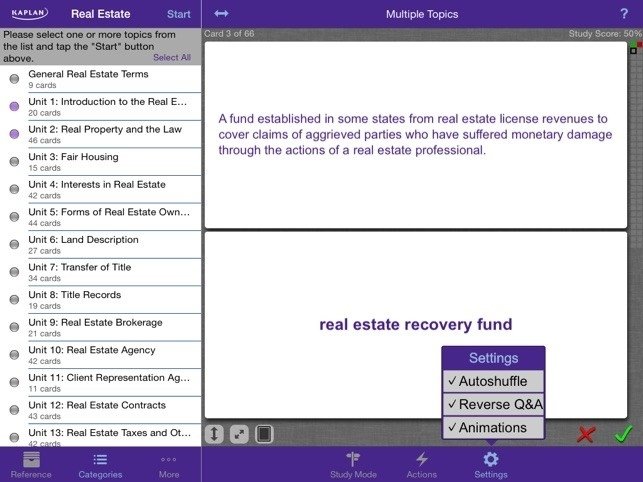
Available in 37 states, The CE Shop focuses on intuitive online delivery ($150-$350). Bite-sized modules, device syncing, and interactive diagrams (e.g., easements, mortgages) suit side-hustlers with limited time. High visual content reduces overload.
Pros: Mobile-friendly, affordable, strong in financing visuals.
Cons: Less comprehensive in some states; no broker tracks everywhere.
Great for investors learning rentals; flexible for veterans.
Real Estate Express
In 38 states, this online-only giant ($199- $499) offers a pass guarantee and over 500,000 alumni. Repetitive reinforcement via videos and quizzes builds retention; job boards aid transitions.
Pros: High pass rates, career resources, unlimited retakes.
Cons: Repetition may bore some.
Perfect for flipping enthusiasts; GI Bill-eligible.
Start your journey affordably. Sign up for Real Estate Express.
360 Training
Budget-friendly ($175-$375) in most states, 360 emphasizes practical forms and niche CE, such as 1031 exchanges. The functional platform focuses on content over flash.
Pros: Broad catalog for investors, hands-on document practice.
Cons: Variable quality by state.
Suits wholesaling pros and military transitions.
Colibri Real Estate
Premium tier ($299-$799) in key states like CA/TX/FL. Live webinars, thousands of practice questions, and experienced instructors provide depth.
Pros: Robust prep, critical thinking focus.
Cons: Higher cost, intense for casual learners.
Ideal for commercial investors; veteran-friendly.
Elevate your skills with Colibri. Join Colibri today.
Aceable Real Estate
Mobile-first in 11+ states ($199-$299), with 5-10 minute lessons for microlearning. Conversational style makes regs engaging.
Pros: Simple, fun, fits pockets of time.
Cons: Limited states.
Best for busy side-hustlers; expanding GI Bill options.
Comparison Table
| Kaplan | $200-400 | 50 | Online/Class | No | Aspiring agents, comprehensive prep |
| The CE Shop | $150-350 | 37 | Online | No | Side-hustlers, flexible learning |
| Real Estate Express | $199-499 | 38 | Online | Yes | Investors, career transitions |
| 360 Training | $175-375 | Most | Online | No | Budget investors, niches |
| Colibri | $299-799 | Key | Online/Live | No | Advanced strategies, serious pros |
| Aceable | $199-299 | 11+ | Mobile | No | Busy career-changers |
This table highlights value—e.g., Real Estate Express’s guarantee justifies mid-range pricing.
Buying Guide
Address pain points head-on:
- Budget: Start under $200 with The CE Shop or 360 Training if cost-sensitive. Invest more in Kaplan/Colibri for guarantees and depth.
- Time/Flexibility: Choose self-paced like Aceable (microlessons) or The CE Shop (device sync) for jobs/family.
- State Needs: Verify with your commission—e.g., TX’s contract forms need specialized content.
- Audience Fit: Aspiring agents: Kaplan’s simulators. Investors: 360’s niches. Veterans: GI Bill-approved like Kaplan/Colibri. Side-hustlers: Aceable’s brevity.
- Avoid Overload: Opt for structured planners (Kaplan) or visuals (CE Shop).
- Extras: Look for CE, job aids, and webinars.
Research reviews on BBB/Trustpilot; trial demos if available. Total licensing costs: $1,000-$2,500, including exams/fees.
Secure flexible learning with The CE Shop. Enroll in The CE Shop.
Conclusion
Choosing the best real estate course boils down to your goals, state, and lifestyle. Kaplan leads for nationwide reliability, Aceable for modern flexibility, and Colibri for premium depth. By addressing high costs, overload, and time constraints, these providers empower aspiring agents, investors, side-hustlers, and veterans to thrive in 2026’s market.
Invest in your future—don’t settle for less. The right course not only gets you licensed but builds lasting competence.
Frequently Asked Questions
How long does it take to complete a real estate course?
The time to complete a real estate course depends on your state’s hour requirements and your study pace. Most states need between 60 and 180 hours of instruction. If you’re taking an online self-paced course and studying part-time, you can typically complete the coursework in 4 to 12 weeks. Full-time students working through the material consistently might finish in 2 to 4 weeks. Traditional classroom courses follow fixed schedules that usually span several weeks with classes held once or twice per week.
What is the pass rate for real estate license exams?
Real estate license exam pass rates vary significantly by state. National averages suggest that approximately 60% to 70% of first-time test-takers pass their salesperson exam. Some states, like Florida, have notably lower pass rates, often below 50% for first tries. California, Texas, and New York also have challenging exams with pass rates typically in the 50% to 60% range. Choosing a course with strong exam preparation components and proven pass rates above state averages improves your chances considerably.
Can I take real estate courses online in any state?
Most states now approve online real estate education for pre-licensing requirements, but there are exceptions and variations. Some states require a portion of your hours to be completed in live instruction, either in person or through synchronous online classes. Other states allow fully self-paced online education. You need to verify your state’s specific requirements with your state real estate commission before enrolling in any course to confirm that the format you choose will satisfy licensing requirements.
How much does it cost to get a real estate license?
The total cost to get a real estate license includes several components beyond just the course fee. Pre-licensing education typically costs $150 to $500, depending on the provider and your state. The licensing exam costs $50 to $100. Background checks and fingerprinting add another $75 to $150. Once licensed, you’ll need to affiliate with a brokerage, join your local Realtor association (typically $300 to $800 annually), access MLS ($25 to $50 monthly), and secure errors and omissions insurance. Total startup costs usually range from $1,000 to $2,500.
What topics are covered in real estate pre-licensing courses?
Real estate pre-licensing courses cover core topics required for competent practice. You’ll study property ownership and land use, including different ownership structures and zoning regulations.
Contract law and real estate contracts form a major component, teaching you how purchase agreements, listing agreements, and other essential documents work.
Financing and lending cover mortgages, loan types, and qualification processes.
Fair housing laws, disclosure requirements, and agency relationships address legal compliance.
Most courses also include real estate math, property valuation, and state-specific regulations.
Do real estate courses expire?
Pre-licensing course completion typically has an expiration period. Most states require you to take your licensing exam within a specific timeframe after finishing your courses, commonly 1 to 2 years. If you don’t pass the exam within that window, you may need to retake some or all of your coursework. Once you’re licensed, continuing education credits usually don’t carry over between renewal periods. You need to complete fresh CE hours for each license renewal cycle.
Is Kaplan good for real estate courses?
Kaplan is one of the most established real estate education providers, operating since 1938 and serving all 50 states. Their courses are comprehensive, and their exam preparation materials are particularly strong, featuring adaptive learning technology that identifies your weak areas. Student pass rates with Kaplan consistently exceed state averages. The main considerations are cost, which tends to be slightly higher than budget providers, and the volume of material, which some students find overwhelming. Their study planner tools help manage this, but you need self-discipline to work through their complete curriculum.
Can you fail a real estate pre-licensing course?
Most real estate pre-licensing courses require you to maintain a minimum score on quizzes and exams throughout the course to show competency. You typically need to score at least 70% to 75% on these assessments. If you fail to meet these thresholds, you’ll need to review the material and retake the assessments. Quality courses provide unlimited retakes on their internal assessments. The bigger concern is passing your state licensing exam, which has more significant consequences for failure, including retake fees and waiting periods.
Leave a Reply